About the book
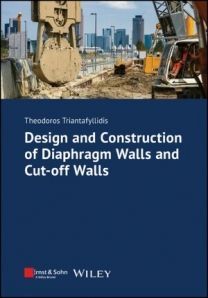
This book provides a clear and concise overview of diaphragm wall and cut-off wall construction methods as well as their limitations. From the design stage until the execution the specialized civil engineering works are complex and very challenging requiring specific knowledge and skills. This book aims to broaden the understanding of consultants, clients and contractors regarding the challenges, limitations, and alternatives of the practical implementation by highlighting various perspectives, thereby enabling the exploration and adoption of new approaches to quality assurance.
The book provides practical guidance from design through to all execution stages, along with detailed descriptions - including graphics and photos - of the procedures, the working equipment, and the measurement or monitoring devices.
Methods of calculation and design approaches are presented clearly with examples throughout the entire construction procedure. Numerous explanations with practical examples also give important hints for the placement of reinforcement and the concreting operations as well as the installation of precast elements in the diaphragm wall. Analyses of possible wall deformations and settlements of adjacent structures due to installation processes are presented. Compositions of supporting slurry mixtures, their preparation, their rheological properties as well as testing are presented in detail. Furthermore, it reveals solutions for difficult situations that may arise due to unknown or unforeseen artificial or natural obstacles or specific site or ground conditions, which may affect the entire construction procedure.
For engineers involved in design and construction, this work represents an indispensable, up-to-date practical handbook. Drawing on his extensive experience with large-scale projects, the author provides valuable insights into the methods described that go beyond the current state of the art.