Latest news
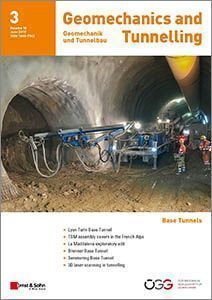
The latest content from our journal Geomechanics & Tunnelling 03/2017: The Mont Cenis Base Tunnel
The New Lyon-Turin Line (NLTL) is an essential component of the ”Mediterranean Corridor“, one of the nine TEN-T network corridors, the future ”European metropolitan railway“ that will promote the movement of people and goods by rail, an ecological mode of transport. The goal is to reduce road transport, which increases pollution and greenhouse gas emissions.
With 12 % of the tunnels already excavated, there are currently 800 people working on the NLTL. This unique project, with its extraordinary history and innovative features, has been proposed as the subject of an international case study.
The full article is available online. Continue reading it in the Ernst & Sohn article database for only 25,- €. Our article database holds more than 31,000 articles from our journals. Directly to the article
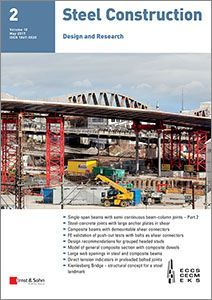
The latest content from our journal Steel Construction 02/2017: Kienlesberg Bridge in Ulm, Germany
Kienlesberg Bridge is the new link for trams, pedestrians and cyclists between the inner city and the science centre in the north-west of Ulm. The bridge crosses a railway junction near the main station and a new high-speed rail link.
The geometric boundary conditions lead to unequal spans and complex alignments. Therefore, the scheme that won the design competition, which is now under construction, proposed a bridge made of steel.
Special calculations and details were necessary for dynamic and noise control reasons. The bridge is being built using incremental launching.
The full article is available online for free. Continue reading it in the Ernst & Sohn article database. Our article base holds more than 30,000 articles from our journals. Directly to the article
Find and download technical articles conveniently in our digital archive
In our digital archive, currently more than 31,000 technical articles published in our journals since 1967, as well as our special issues, are available as PDF.
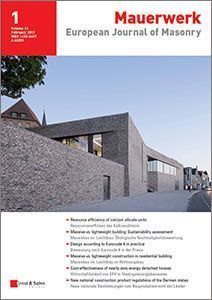
Massive versus lightweight building: the latest investigations of (ecological) sustainability assessment
Over recent years, the authors have released various research findings concerning the sustainability of masonry construction for detached houses and apartment buildings in comparison with alternative construction methods (timber, reinforced concrete). Meanwhile, in cooperation between the Institute for Concrete and Masonry Structures, TU Darmstadt, and its spinoff LCEE Life Cycle Engineering Experts, these analyses have been merged to a further study with increased consideration of all relevant construction methods for multi-floor residential buildings.
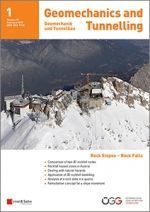
Dealing with natural hazards along federal and state roads in Bavaria
Roads in the municipal Berchtesgaden are among the traffic infrastructure in Germany most highly endangered by natural hazards. Landslide, avalanche, rockfall and debris flow events led to repeated accidents and road closures. In order to improve the safety of main roads, a three-stage approach has been introduced by the responsible road authority, especially in the light of finding the most suitable and sustainable solutions quickly. The main criteria for the entire design phase of any measure have always been the necessary level of protection, reasonable costs and environmental compatibility. Matching all these requirements is critical for rapid construction and therefore a reasonable use of resources.
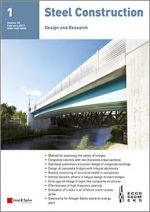
Design and construction of the complex steel structure for the Amager Bakke waste-to-energy plant
Amager Bakke (English: Amager slope) is the name of Copenhagen's new waste-to-energy-plant located on the Amager peninsula. Once finished, it will be one of the largest incinerators in northern Europe and will be used for the combined production of district heat and electricity. On top of the waste-to-energy plant there will be a landscaped park featuring artificial ski slopes and a viewing platform. The support structure is mainly formed by a steelwork. The model-based design and construction of the complex, three-dimensional steel structure proved to be a challenging task for all the engineers and companies involved.
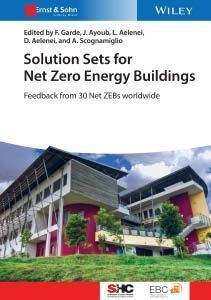
New publication in spring time 2017
Solution Sets for Net-Zero Energy Buildings will be available in April 2017.
A new title in the series of Solar Heating & Cooling Programme.
See all titles published in this series:
www.ernst-und-sohn.de/en/shc
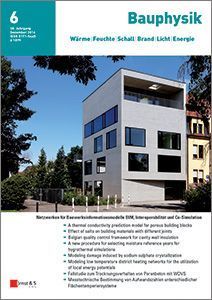
Selected Papers from CESP 2016 and BauSIM 2016 IBPSA Conference - ONLINE FOR FREE
Six best-of papers from the two conferces CESBP 2016 (Central European Symposium on Building Physics) and BauSIM 2016 IBPSA Conference (International Building Performance Simulation Association) have been published in Bauphysik (Building Physics) 06/2016 in English.
One article is available online for free via Wiley Online Library: A thermal conductivity prediction model for porous building blocks by ir. Wouter Van De Walle and Prof. dr. ir. Hans Janssen. We offer a special price for the other papers.

Most read articles from our journals in 2016
In 2016 we have again published many interesting articles in our English journals Steel Construction, Geomechanics & Tunnelling and Mauerwerk - European Journal of Masonry. We would like to present the most-read articles in 2016. One article from each journal we have made available for free for you to read or download via Wiley Online Library. If you are interested in more selected articles or would like to subscribe to any of our journals, contact us via marketing@ernst-und-sohn.de. We have introductory special offers for all of our journals.
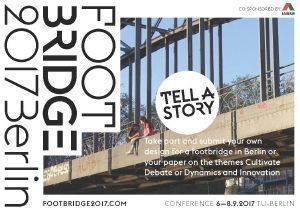
Footbridge 2017 in Berlin
The deadline for submission of abstracts and for registering to submit a bridge design is extended until 15 January 2017!
The reason for this is that the organiser had several requests from colleagues who would like to submit but will still be on vacation until January 6th.