
Latest news

Impact Factors 2015 slightly adjusted upwardly
Thomson Reuters recently published the impact factors 2015 for scientific journals. Our journal Beton- und Stahlbetonbau (Concrete and Reinforced Concrete Structures) is still our most-cited German language journal, followed by Bautechnik (Construction Technology) and Stahlbau (Steel Structures). The journal Structural Concrete has achieved a notable place in the international landscape of scientific journals for civil and structural engineering.

Brand new!: Engineered Transparency 2016
This book contains more than 70 articles and presents international trends in structural glazing and facade construction. Renowned authors from all over the world report on current research results and innovative construction projects.
European Journal of Masonry 04/16
New approach for spacing of movement joints in reinforced and unreinforced masonry veneer walls.
by Prof. Ir.arch. Dirk R.W. Martens
The spacing of movement joints has been subject of many discussions. The current methods for the determination of the spacing of movement joints are based on local traditions and bad experience with cracked veneer walls. This has resulted in various design rules throughout Europe with very stringent limits for spacing of movement joints. According to EC6, one of the solutions for increasing the spacing of movement joints is to introduce bed joint reinforcement, although unfortunately no specific design rules are given. Until now, most scientific research has been focused on numerical simulations without taking time-dependent effects into account, which is a conservative approach. In this paper, a new approach is described. It is based on Peter Schubert's model and on practical experience with masonry buildings.
The full article has been published in issue 04/2016 of the journal Mauerwerk - European Journal of Masonry.
Geomechanics & Tunnelling 04/2016
TBM Tunnel under the Bosphorus for the Istanbul Strait Road Crossing Project
The population increase in Istanbul is also reflected in car ownership, which brings an extensive traffic load to the city, especially to the two bridges over the Bosphorus. After feasibility studies, a double deck, 3.4 km subsea tunnel with a 13.7 m diameter at a maximum depth of 106 m below sea level and a capacity of 100,000 cars/day was initiated as a solution for the city. The tunnel, excavated by a custom-made mixshield slurry TBM, passes through very complex geological structures including the Trakya formation, transition zones and marine sediments in a highly seismic area.
The full article is published in issue 04/2016 of the journal Geomechanics & Tunnelling.
Reading Recommendation: TBM Excavation in Difficult Ground Conditions - Case Studies from Turkey
Steel Construction 03/16
Romanian projects and integral bridge solutions based on composite dowels
by Assoc. Prof. Dr.-Ing. Edward Petzek, Dipl.-Ing. Victor Schmitt, Dipl.-Ing. Elena Meteş, Dipl.-Ing. George Ispăşoiu and Dipl.-Ing. Alexandru Ţurcan
The design and construction of sustainable and durable bridges with low maintenance costs is one of the tasks of road and railway administrations of the European Countries. The structures must be safe, economical and need less maintenance during their service life. All these needs can be found in integral abutment bridges. This solution, which eliminates the bearings and expansion joints, leads to low construction and maintenance costs. Integral bridges also have good earthquake resistance. Bridges are vital structures in the transport infrastructure; it is a fact that, in the last decades, composite bridges have become a popular solution in many European countries as a cost-effective and aesthetic alternative to concrete bridges. Their competitiveness depends on several aspects, such as site conditions, local costs of materials and personnel and the contractor's experience.
The full article is published in issue 03/2016 of the journal Steel Construction.

New publications autumn 2016
New publications from the areas:Steel Construction and Geotechnical Engineering.
Structural Concrete 02/16
Taken from the technical paper Background to the European seismic design provisions for retrofitting RC elements using FRP materials:
"[...] Fibre reinforced polymers (FRP) were introduced into civil engineering practice in the early 1990s, but they only became popular after they became known for their effectiveness as a fast remedy when retrofitting damaged reinforced concrete and masonry structures in the wake of the catastrophic earthquakes at the end of that decade (Northridge, 1994, Kocaeli, 1999, Athens, 1999). Since that time, extensive research has been undertaken to support design procedures for retrofits with FRP wraps and laminates, leading to several versions of design guidelines. [...] A large part of the research effort was directed towards the development of confinement models, whereas all other actions were primarily considered for static loads (shear and anchorage). Earthquake retrofit detailing was hampered by the need to address global structural response issues as well in order to determine the retrofit priorities, whereas the literature on models that could support the development of guidelines was already marked by significant discord regarding the deformation indices of retrofitted behaviour, thus complicating the detailing process.
The aim of this paper is to establish a new-generation framework for the design of seismic retrofits using FRP materials. Following prevailing earthquake and design practice, the paper establishes performance-based criteria for global and local retrofit requirements so that the rehabilitated structure can develop acceptable, repairable levels of damage in a severe earthquake and minimal (limited) levels of damage in the frequent event. The aims of FRP retrofit designs are the enhancement of strength and deformation capacity as well as the mode of failure control of the structure and its individual structural members. It is intended that this paper should serve as the background for the development of European seismic retrofit provisions using FRPs. [...]"
The full article is available online for free until November 19th, 2016. Contiune reading on WileyOnlineLibrary.
P.S. If you are interested in more free content, sign up for our monthly newsletter. We regularly feature articles from our journals.
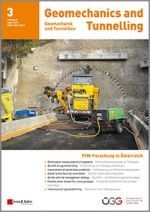
Geomechanics & Tunnelling 03/2016
"[...] The ÖBB-Infrastruktur AG initiated a TBM research project in 2012 with the involvement of consultants, university institutes, contractors and machine manufacturers, supported by experience from completed tunnel drives with tunnel boring machines (TBM) in Austria. The objective was and is to develop an understanding of all processes of TBM tunnelling, as is already available for NATM tunnelling, in order to generate the greatest possible technical and benefits of on mechanised tunnel drives.
In this issue, we have picked out a few subjects, which should give an insight into the wide range of progressive approaches and innovations. Several new developments could already be successfully tested in practice on the running TBM drives on contract KAT2 of the Koralm Tunnel. The development and construction of a segment test rig at the Montanuniversität Leoben, which is reported by Gehwolf et al, is certainly unique in Austria. In the course of this work, a fibre optic system to measure deformation in segments has been successfully applied. [...]"
Taken from the editorial of Geomechanics & Tunnelling 03/2016. Read full article on WileyOnlineLibrary.
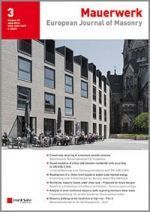
European Journal of Masonry 03/16
An Editorial by Torsten Schoch, "[...] Masonry in a world of challenges: Although this motto may sound a bit exaggerated to one or the other, it can be seen as reasonable and prudent in this issue of the journal. The first article in this issue offers answers to the frequently encountered question, what to do with the masonry after the demolition of the building. [...] The objective is to produce and implement technologically and economically feasible products in order to relieve landfill sites and ensure a closed material cycle in the future if possible. This is still far away. [...]"
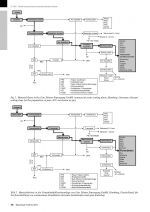
Closed-loop recycling of autoclaved aerated concrete
Xella Technology and Research, in a pilot study with the Hamburg-based Otto Dörner GmbH waste management company and the Ytong plant in Wedel, has been testing since 2013 how and in what amounts autoclaved aerated concrete (AAC) remains from demolished buildings or from waste disposal sites can be reused for new AAC production. The processing of the salvaged AAC-material should conform to the current technical standard: return of mixed demolition rubble, separation of contaminants (by metal separation, air density separation, swim-sink separation, manual resorting), pre-treatment in the crusher and sieves for predetermined grain size ranges. This is where grain sizes or moisture content, heavy metals, bitumen, sulphate or other impurities are analysed in detail. The sorting accuracy as performed by Otto Dörner has shown to be sufficient for reuse through reintroduction into AAC-production. Up to 15 % salvaged AAC prepared in such a manner can be effortlessly reused. A sample production of AAC quality grade P4-0.55 with granulated salvaged AAC in the Ytong plant in Wedel was successful.
Continue reading this article on Wiley Online Library for free.